 by
by Correctional officer skills are essential for anyone looking to thrive in this demanding field.
From maintaining security to managing interpersonal interactions, these abilities help specialists navigate their responsibilities and challenges effectively.
In this article, we’ll explore the key skills for resume of a correctional officer, from conflict resolution to physical stamina. Whether you are just starting out or looking to enhance your competencies, mastering these will position you for a rewarding career.
Why correctional officer skills matter for a resume?
Correctional officers serve a crucial role in maintaining order and ensuring a secure environment within detention facilities.
Their effectiveness doesn’t hinge solely on rule enforcement — it’s grounded in how well they navigate tense, unpredictable circumstances with control, insight, and composure.
Strong detention officer skills don’t just get you through the shift — they allow you to lead, resolve issues quickly, and promote a more stable facility for everyone.
Guards must act decisively and with precision when facing:
- Potential confrontations between inmates
- Urgent health or security incidents
- Volatile behavior from individuals in custody
Even minor hesitation or poor judgment can trigger serious consequences.
Create your professional Resume in 10 minutes for FREE
Build My Resume
Core correctional officer skills
Whether you're just starting or have years of experience, highlighting the right correctional officer skills in resume can be the difference between getting noticed or passed over.
1. Situational Awareness and Observation
Being alert is a top priority in correctional settings. Officers must monitor inmate behavior, detect early signs of unrest, and react to changing situations quickly.
Maintained 24/7 surveillance over inmate activities using direct observation and security camera systems, identifying behavioral anomalies to prevent escalation of conflicts.
- How can I build the situational awareness and observation skill?
- Practice through security simulations, mindfulness exercises, or even civilian observation jobs like retail loss prevention.
2. Conflict De-escalation
Managing tension without force is a crucial talent. Remaining composed under stress helps prevent minor disputes from becoming major incidents.
Resolved inmate disagreements using calm verbal redirection and rapport-building strategies, reducing the number of use-of-force interventions within the unit.
- How can I build the conflict de-escalation skill?
- Study communication psychology, participate in roleplay simulations, and observe experienced professionals handle volatile situations.
3. Documentation and Reporting
Written records are the backbone of institutional accountability. You must detail events, behavior, and policy violations with accuracy and professionalism.
Authored clear and concise reports on daily activities, disciplinary actions, and incident responses, ensuring compliance with facility standards and audit requirements.
- How can I build the reporting correctional officer skills?
- Practice structured report writing, take documentation courses, and review real samples with supervisors.
4. Physical Readiness and Tactical Response
The role demands stamina and strength, especially during emergencies. Officers must be capable of physically responding to threats without hesitation.
Successfully completed advanced fitness evaluations and assisted in subduing aggressive individuals using certified restraint procedures.
- How can I build the physical readiness skill?
- Maintain regular exercise routines, attend defensive training workshops, and update certifications like First Aid and crisis response.
5. Communication
Strong interpersonal correctional officer skills support authority and reduce hostility. Those who communicate clearly and respectfully often gain greater compliance.
Fostered professional relationships with inmates while maintaining boundaries, improving cooperation during cell checks and facility transitions.
- How can I build the communication skill?
- Enroll in conflict communication workshops, practice active listening, and get feedback from team members on tone and clarity.
6. Policy Knowledge and Legal Understanding
Prison staff must follow complex regulations. Familiarity with institutional guidelines and boundaries ensures ethical and lawful conduct.
Applied correctional codes and inmate rights regulations consistently, contributing to positive audit outcomes and reduced legal grievances.
- How can I build the legal understanding skill?
- Study law manuals, attend refresher courses, and review updates from your jurisdiction’s Department of Corrections.
7. Emergency Response Coordination
In crisis situations, decisive action saves lives. You must act swiftly and work with others to contain threats, administer aid, or initiate lockdowns.
Participated in emergency drills and real-time crisis responses, including fire evacuations and facility lockdowns, while maintaining clear communication with command staff.
- How can I build the emergency response coordination skill?
- Engage in quarterly response training, practice communication protocols, and volunteer for planning committees.
8. Team Cohesion and Operational Discipline
Success in correctional environments depends on unity and respect for the chain of command. Officers must cooperate seamlessly with diverse personnel.
Operated in close coordination with shift teams, medical staff, and transportation units, ensuring smooth operations during high-risk inmate transfers.
- How can I build the operational discipline skill?
- Join team-building exercises, attend interdepartmental briefings, and reflect on peer feedback during performance evaluations.
9. Ethical Judgment and Integrity
Prison guards are entrusted with significant authority, making strong moral principles and sound judgment essential for maintaining public and institutional credibility.
Consistently upheld professional standards in challenging situations, reported misconduct promptly, and earned recognition for ethical decision-making during internal reviews.
- How can I build the ethical judgment correctional officer skills?
- Study your facility’s code of conduct, seek mentorship from seasoned officers, and participate in ethics and accountability workshops.
10. Cultural Competence and Diversity Awareness
Incarcerated populations are often diverse in background and belief. You must navigate differences with respect and adaptability.
Demonstrated cultural sensitivity by effectively communicating with inmates from varied backgrounds, reducing misunderstandings and fostering mutual respect in communal living spaces.
- How can I build the diversity awareness skill?
- Take courses on diversity and inclusion, practice language and communication flexibility, and reflect on personal biases through training sessions.
Examples of correctional officer resume skills
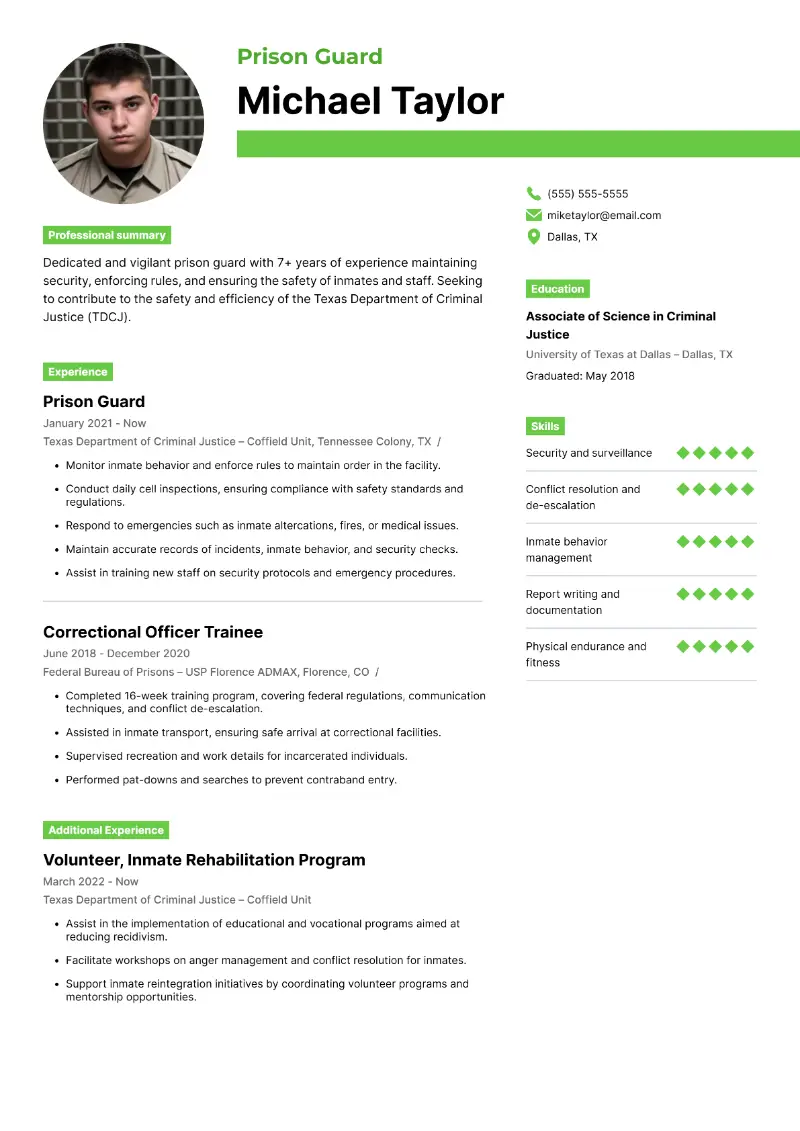
Prison guard skills for resume
Jordan Walker
Los Angeles, CA | jordan.walker@securemail.com | (213) 555-4832 | LinkedIn.com/in/jwalker-correctionsSummary
Disciplined and observant Correctional Officer with experience maintaining order, safety, and legal compliance in high-security correctional environments. Skilled in de-escalation, emergency response, and team coordination with a strong focus on ethical conduct and documentation. Adept at building rapport with diverse inmate populations while upholding strict institutional policies.
Skills
- Situational awareness and threat detection
- Conflict de-escalation techniques
- Legal policy enforcement
- Emergency response coordination
- Report writing and documentation
- Interpersonal and cross-cultural communication
- Defensive tactics and physical control
- Ethical decision-making
- Chain-of-command operations
- Team collaboration under stress
Experience
California State Prison, Los Angeles County
Senior Correctional Officer | Lancaster, CA | Jan 2021 – September 2025
- Monitored inmate behavior and cell block activity, using direct observation and surveillance systems to detect signs of unrest or planned disruption.
- De-escalated daily conflicts through non-violent communication methods, reducing use-of-force incidents by over 40% within two years.
- Led rapid response during six facility lockdowns, coordinating medical and tactical units under chain-of-command protocols.
- Trained new recruits on PREA compliance, facility procedures, and crisis intervention techniques.
Twin Towers Correctional Facility
Correctional Officer | Los Angeles, CA | Jun 2017 – Dec 2020
- Conducted routine security inspections and headcounts for a 1,000-bed unit, ensuring compliance with institutional policies and inmate rights.
- Responded to fire drills, medical emergencies, and code red alerts, initiating immediate lockdown procedures when required.
- Authored over 500 incident reports used in disciplinary hearings and court-related documentation.
- Fostered effective communication with inmates from multiple cultural backgrounds, aiding peaceful resolution of disputes.
Education
Associate of Science in Criminal Justice
El Camino College | Torrance, CACertifications
- CPR and First Aid – American Red Cross (2024)
- Correctional Officer Defensive Tactics – POST Certified (2023)
- PREA (Prison Rape Elimination Act) Compliance – CDCR (2023)
Additional Information
- Member, California Correctional Peace Officers Association (CCPOA)
- Bilingual: English and Spanish
Skills for a correctional officer resume
Detention officer skills for resume
Tiana Brooks
Houston, TX | tiana.brooks@justicepro.net | (832) 555-2029 | LinkedIn.com/in/tiana-brooksSummary
Proactive and reliable Correctional Officer with experience in medium- and high-risk correctional settings. Combines strong physical readiness with excellent interpersonal communication, policy knowledge, and ethical leadership. Recognized for improving inmate relations and reducing incident frequency through cultural sensitivity and real-time observation.
Skills
- Threat assessment and behavioral monitoring
- Verbal conflict management
- Facility operations and chain-of-command coordination
- Policy enforcement and legal compliance
- Documentation and incident logging
- Cultural competence and diversity awareness
- Tactical response and restraint procedures
- Ethical conduct under pressure
- Communication with vulnerable populations
- Emergency evacuation protocols
Experience
Harris County Sheriff's Office, Jail Division
Correctional Officer | Houston, TX | Feb 2019 – Present
- Supervise inmate housing units, identifying abnormal behavior patterns and reporting early warning signs to mental health staff.
- Handle volatile interactions with professionalism and empathy, preventing escalation using conflict resolution tactics.
- Participate in bi-monthly emergency drills, preparing staff for fire, medical, and security-related crises.
- Receive quarterly commendations for consistent ethical conduct and adherence to department policy.
Montgomery County Jail
Detention Officer | Conroe, TX | Mar 2015 – Jan 2019
- Maintained strict logs of inmate movements, disciplinary actions, and daily routines in compliance with auditing protocols.
- Assisted with high-risk inmate transports, coordinating security and medical teams to ensure incident-free transfers.
- Built effective communication channels with inmates from varied cultural backgrounds, enhancing cooperation and reducing misunderstandings.
- Acted as point-of-contact for training on PREA standards and rights-based interactions.
Education
Bachelor of Science in Law Enforcement Administration
Sam Houston State University | Huntsville, TXCertifications
- Emergency Response Operations – TCOLE (2025)
- CPR/AED & Basic Life Support – American Heart Association (2024)
- PREA Awareness Training – National Institute of Corrections (2023)
Additional Information
- Volunteer, Texas Reentry Programs Initiative
- Fluent in English and Haitian Creole
Conclusion
Developing a strong foundation for a correctional officer resume is crucial for those looking to excel in this challenging and rewarding profession.
By focusing on key areas such as communication, situational awareness, and physical fitness, you can ensure that you are well-prepared for the complexities of the role.
Continuous training and personal growth are also important for staying ahead in the field and contributing positively to the correctional environment.
Create your professional Resume in 10 minutes for FREE
Build My Resume