 by
by An MLA cover letter can play a key role in how your academic or professional entry is received.
Whether you're applying for a research position, submitting a paper, or reaching out to a department, a well-written document helps establish credibility and intent.
In this article, you’ll learn how to craft an effective academic cover letter that communicates your goals clearly.


What is MLA cover letter format?
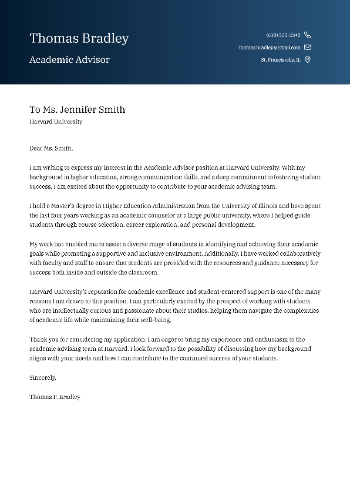
MLA is a professional layout used for academic or research-related submissions.
Unlike other types of cover letters, the focus here is on maintaining clarity and structure while adhering to the Modern Language Association’s guidelines.
Here’s how the MLA academic cover letter format works.
Layout Overview
Start with your personal details at the top of the page. This is followed by the recipient's information, flush with the left edge. The date is placed beneath, written in the format "day month year" (e.g., 5 May 2025), without any punctuation.
Spacing and Alignment
Maintain single spacing throughout the document, leaving a blank line between paragraphs to create visual separation. The text should be aligned to the left—no indentation is used.
This linear arrangement ensures a tidy and easy-to-scan structure.
Typeface and Margins
Choose a legible, professional font such as Times New Roman, sized at 12 points. Surround the content with 1-inch margins on every side, which provides a balanced and consistent visual frame.
Ending the Letter
Conclude with a formal sign-off, such as “Sincerely,” followed by space for a handwritten signature if printed. For digital submissions, typing your name beneath the closing phrase is sufficient.
- MLA vs. APA Format Cover Letter: Key Differences
In academic writing, both are widely used citation styles, but they have distinct rules. To help you understand the distinctions, here’s a quick comparison table.
| Element | MLA Cover Letter | APA Cover Letter |
|---|---|---|
| Layout | Left-aligned contact info, recipient’s data, and date. Employ formal tone throughout. | Left-aligned contact details and recipient’s info; informal tone often for personal communication. |
| Date Format | Day Month Year (e.g., 5 May 2025) | Month Day, Year (e.g., May 5, 2025) |
| Salutation | "Dear [Title] [Last Name]" | "Dear [First Name]" or "Dear [Title] [Last Name]" |
| Closing | "Sincerely," | "Best regards," or "Sincerely," |
| Spacing | Single-spaced with double-spacing between paragraphs. | Double-spaced throughout, including the letter and references. |
| Font | Times New Roman, 12 pt. | Times New Roman, 12 pt. |
| Margins | 1-inch on all sides | 1-inch on all sides |
Create your professional Cover letter in 10 minutes for FREE
Build My Cover Letter
Key components of an MLA format cover letter
Your Contact Details
- Full name
- Address (city, state)
- Phone number
Recipient's Information
- Full name
- Title (e.g., Professor, Dr., Director)
- Department (if applicable)
- University/Organization name
- Address
Date
After the header, include the date in this format: Day Month Year.
5 May 2025
Salutation
Start with a formal greeting. If you have the specific recipient, write “Dear [Title] [Last Name]”.
Dear Professor Smith,
If you don’t know the name, opt for a general phrase like “Dear Hiring Manager”.
Body Paragraphs
The main part should be divided into several blocks.
- Opening: Briefly introduce yourself and explain the purpose of your writing (e.g., applying for a position, submitting a paper).
- Main Content: Here, describe your qualifications, experience, or the reason you are submitting a paper or research. Make sure to keep it concise and relevant.
- Conclusion: End with a polite statement, such as “Thank you for considering my application,” followed by a formal closing, e.g., “Sincerely,”.
An MLA cover letter should typically be one page long. Stick to relevant details and avoid unnecessary information.
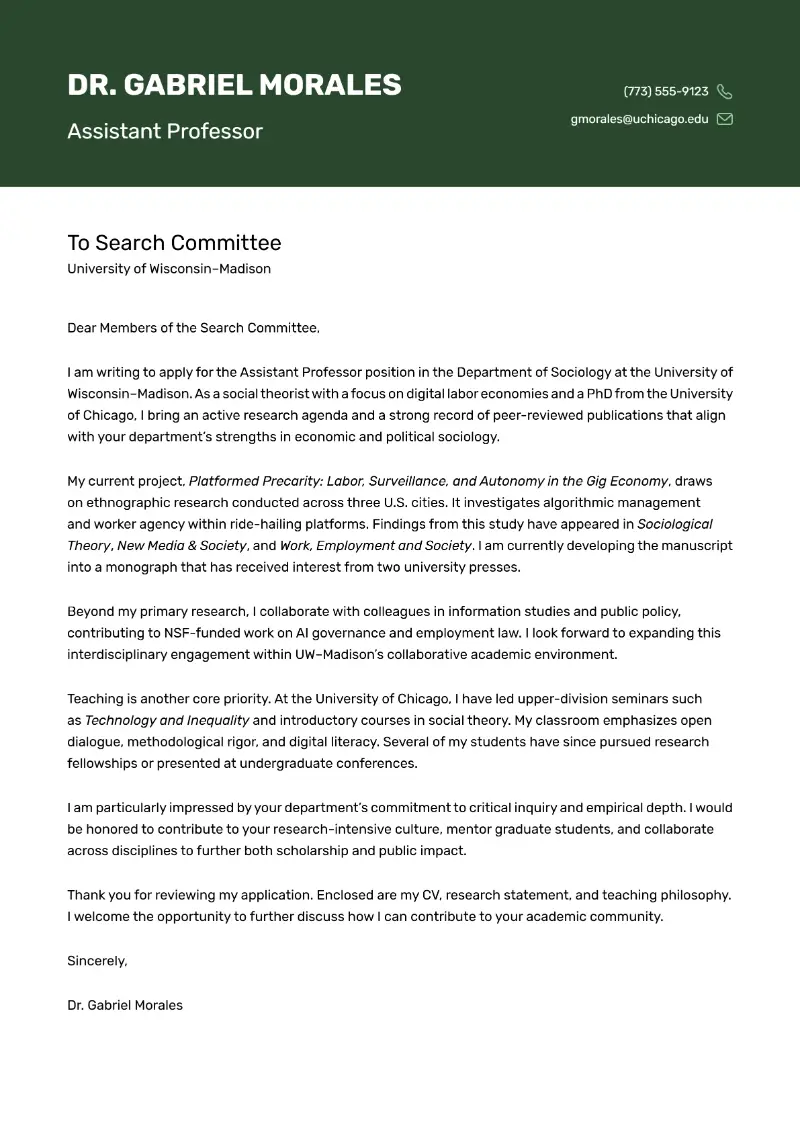
MLA academic format cover letter examples
Alexandra Moreno
152 Waverly Place
New York, NY 10014
amoreno@email.com
(917) 555-0147Dr. Marcus Yates
Department of English
Hamilton University
326 College Lane
Albany, NY 122225 May 2025
Dear Dr. Yates,
I am writing to express my interest in the graduate research assistant position within the Department of English at Hamilton University. As a recent graduate with a Bachelor of Arts in English Literature from Columbia University, I am eager to contribute my analytical skills and academic background to your department’s ongoing projects in early American literature.
During my undergraduate studies, I completed a senior thesis on Puritan narratives and their influence on modern storytelling, which deepened my interest in colonial-era texts. I also worked as a peer writing tutor for two years, assisting students in refining their academic essays across various disciplines. These experiences have not only sharpened my research and communication skills but also confirmed my desire to pursue collaborative work in literary scholarship.
I am particularly interested in your current research on transatlantic print culture, as discussed in your recent publication in Early American Literature. I would be honored to support your work while gaining valuable experience in archival research and academic writing.
Thank you for considering my application. I have attached my resume and writing sample for your review. I would welcome the opportunity to discuss how my background aligns with your department’s research goals.
Sincerely,
Alexandra Moreno
Conclusion
Crafting a well-structured cover letter in MLA style can elevate the professionalism of your academic or research paper.
By following these guidelines for formatting, tone, and organization, you ensure that your document meets the expectations of academic reviewers and institutions.
Whether you're applying for a fellowship, submitting a paper, or contacting a department, a clear and properly formatted cover letter can make all the difference in how your materials are received.
Create your professional Cover letter in 10 minutes for FREE
Build My Cover Letter